
IThe scale of the phenomenon, measured
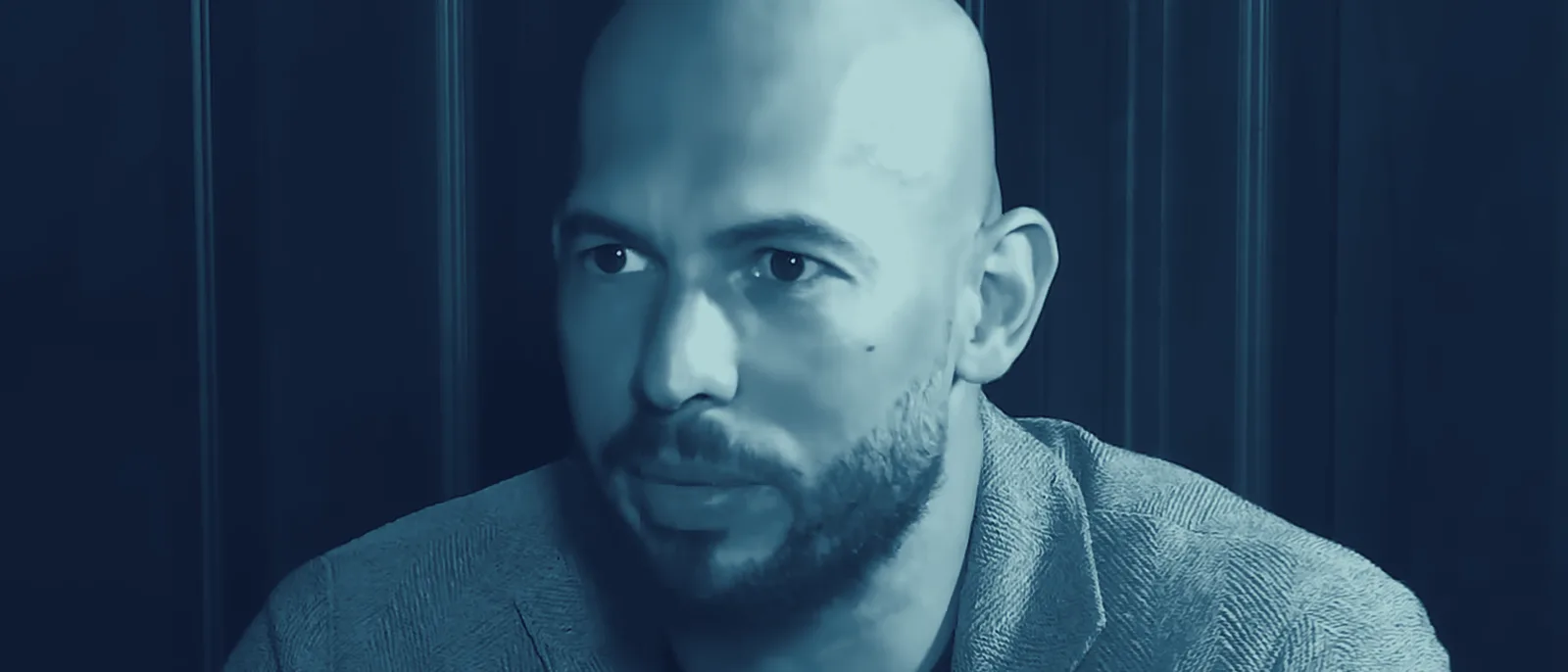
The British numbers are the best established, and they are enough to state the problem. Among boys aged 16 and 17, the share who have consumed Andrew Tate content exceeds by twenty-one points the share who know who their own Prime Minister is. That is not a statistic about an influencer. It is the finding that public speech has lost its monopoly.
Better known than the Prime Minister
BRITISH BOYS AGED 16-17 · IN % · DATA CITED BEFORE THE UK PARLIAMENT
BRITISH SURVEY, 2023, CITED IN PARLIAMENTARY WORK (WOMEN AND EQUALITIES COMMITTEE). SUNAK WAS THEN PRIME MINISTER.
Approval follows recognition, with a gender asymmetry that is the central political fact: one young man in three holds a positive view of Tate, against fewer than one young woman in ten. Among 16-17-year-old males, an absolute majority. YouGov even measures one boy in six among 6-15-year-olds. Two halves of a single generation are forming irreconcilable views of the world, in spaces that neither school, nor the media, nor the parties ever enter.
A gender divide, not a fashion
POSITIVE VIEW OF ANDREW TATE · IN % · HOPE NOT HATE / YOUGOV, UNITED KINGDOM
SOURCES: HOPE NOT HATE (16-24 AND OVERALL), YOUGOV (AGES 6-15: ONE BOY IN SIX HOLDS A POSITIVE VIEW).
IIThe ban that banned nothing
August 2022: TikTok, Meta and YouTube remove Tate’s accounts, then credited with billions of cumulative views. By every platform logic, the phenomenon should have died. It flourished, and the reason is structural: Tate was not an account, but a distribution architecture. His paid programme rewarded thousands of subscribers for cutting his interviews into clips and republishing them from their own accounts, the algorithm favouring the most divisive extracts. Removing the central account destroyed neither the stock of content, nor the fleet of relay accounts, nor the economic incentive. The platforms banned a man; the system kept running.
There lies the technical lesson of the case: moderation aimed at the transmitter; the influence lived in the network of retransmission. Any organisation, state or private, that sizes an informational threat by counting followers makes the same category error.
IIIFrom audience to ballot box
The political conversion happened in plain sight. In the United States, the 2024 campaign was fought in part in the male podcast space, whose audiences overlap the manosphere’s; the vote of men aged 18 to 29 swung by roughly twenty-five points in four years, a reversal without equivalent in any other segment of the electorate. In Romania, the presidential election of November 2024, carried by a TikTok campaign outside every rule, was annulled by the Constitutional Court; Tate, based in Bucharest, was among the amplifiers of the first-placed candidate. In February 2025, his departure from Romania for the United States involved exchanges at government level. An influencer had become a matter of state.
Then the conversion stopped being a metaphor. On 7 January 2025, Tate announced his own British party on X, where his once-banned account had been restored: BRUV, for Britain Restoring Underlying Values. The manifesto, ending foreign aid, mandatory combat sports in schools, zero tolerance on illegal migration, was announced from house arrest in Romania, and the party was not even registered with the Electoral Commission. It was widely ridiculed. That is not the point. The point is the direction of travel: a man who assembled an audience of fourteen-year-olds in 2022 was, three years later, offering their elder brothers a ballot line, and the established parties had no channel on which to answer him.
The swing of young American men
PRESIDENTIAL VOTE OF MEN AGED 18-29 · IN % · CIRCLE / TUFTS, EXIT POLLS
THE TEAL LINE FOLLOWS THE REPUBLICAN VOTE, THE OBJECT OF THE SWING. ORDERS OF MAGNITUDE FROM CIRCLE (TUFTS) AND 2020-2024 EXIT POLLS.
The institutions were counting followers. The phenomenon was a paid network of retransmission.
SUMMARY OF THE STUDY- Institutional standing protects nothing. When a Prime Minister is less identified than an influencer among 16-17-year-olds, the problem is not the influencer. It is the absence of the institutions from the ground where that generation gets its picture of the world.
- Watch architectures, not accounts. The relevant unit of modern influence is the network of retransmission and its economic incentive. A ban that leaves both intact is a victory on paper.
- Tomorrow’s electorate forms ten years before it votes. The worldviews that will decide the elections of 2035 are settling today in fourteen-year-olds. Whoever does not speak to them leaves that work to others.
- The gender divide is the rising political variable. Two halves of one generation are diverging at speed. Any electoral or opinion strategy that treats “the young” as a bloc is already wrong.